

HONORS EXPERIENCES
As a part of the Honors college, it is required a minimum of five experiences. Below, I will talk about how each experience did not feel mandatory, what I accomplished, and how I grew as a result.
Final Paper
1st and 2nd Experience
Protege Program: Long-Term Dose Controllable Drug Release
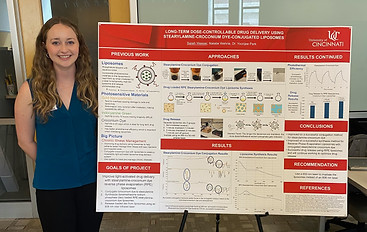
During the summer of 2024, I had the amazing opportunity to participate in the Protégé Program at the University of Cincinnati. This program was made up of first-year engineering students who performed at a high level during the previous fall semester. I worked under Dr. Yoonjee Park for her Long-term dose-controllable drug delivery research project. The research project focused on finding a way to help manage chronic illnesses by encapsulating a drug that helps with inflammation into liposomes. The encapsulated liposomes would then be irradiated with a near-infrared laser to release the drug to the designated spot where the inflammation was. Through this 14-week opportunity, I was trained on several lab machines that were used to analyze samples of liposomes that I created in the lab. I used machines like a dynamic light scattering spectrometer, an ultraviolet-visible spectrometer, and a Fourier transform infrared spectrometer. These machines were used to analyze the size of the liposomes created, the absorbance ranges of the liposomes, and the chemical composition of the liposomes, respectively. I gained a lot of lab experience and knowledge about the research world that I will carry with me throughout the rest of my career.
This experience has impacted my definition of Global Citizen Scholar as I realize more that global, citizen, and scholar go hand in hand. The scholarly work that I completed over the summer, will help others with chronic illnesses have a better life. This, in my opinion, helps me be a better citizen because I will help my fellow citizens who are not as fortunate.

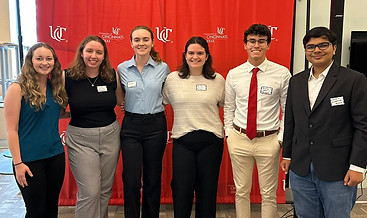
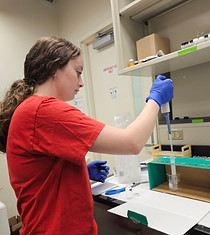
Above, I have 2 images of me at the Protege Showcase. One with my poster presentation, and one with the other winners of the paper competition. I have also attached an image of me in the lab doing a filtration of our liposomes. I have also attached my first place final paper as well as my final presentation if one would like to read/watch an indepth description of what I accomplished the summer of 2024.
3rd Experience
Climate Change Action Seminar
During my semester in Climate Change Action Seminar in the Fall 2024 semester, I learned several skills that will help me in the future when discussing climate change. One major thing that I learned was how to effectively communicate to individuals who have opposing views on climate change. Before taking this course, I would get flustered and when I tried to communicate my points of view they would tend to get defensive. I learned different approaches to take depending on and individual's point of view. For example, if someone thought that CO2 emissions are the only cause of climate change, I would ask the individual: where is it warmer, the forest or a meadow, the meadow or the city? This would open their eyes to the fact that cutting down trees also leads to climate change. Another major thing I learned in this course was how to effectively educate individuals about climate change. Our group created an Instagram page that gave our followers helpful tips and tricks to reduce their plastic waste and to make their lives greener. Our goal of this page was to help people live their lives greener to help slow down the changing climate. Throughout the semester, we had gained several followers based on our content. It was motivating that people are willing and passionate to learn how to change their habits to be greener. It was motivating in the sense that I wanted to keep educating them about innovative ways and simple changes they can take to make a change.
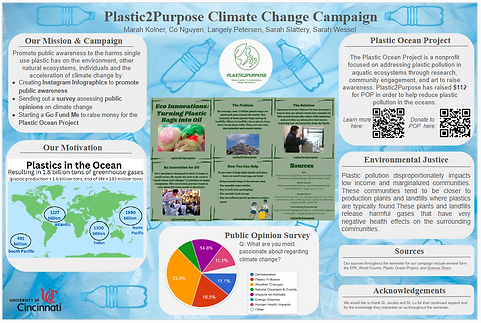
Our final poster presentation based on our climate change campaign. We presented our campaign to the Environmental Justice poster presentation for UC students.
Climate Change A to Z Book
Survey of Individuals Points of View on climate change
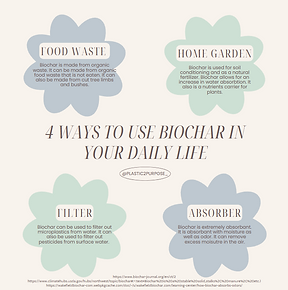
The poster at the top is a cumulation of everything that my group in this seminar had completed throughout the semester towards our climate change campaign. It has a one of several infographics that we posted to our instagram page as well as our fundraising efforts for the Plastic Ocean Project. Below the poster is another one of our infographics describing biochar which something that I had learned about in this class. The top PDF is a book from A to Z where each letter relates to something with the climate. The bottom PDF is our survey that we sent out on our instagram page to get individuals point of views on climate change and how it impact them.
4th Experience
Chocolate and Power Seminar
During my semester in Chocolate and Power Seminar in the Spring 2026 semester, I learned about chocolate and how it has evolved over the course of centuries. Going into this class, I didn’t realize how little I knew about chocolate regarding its growth, harvest, and production of the bars we see on the shelves of every gas station or supermarket. We were able to go to the Kron Conservatory to see an actual cacao tree and see the flowers that the pods with the cacao seeds grow from. In addition, our class went to a small chocolate manufacturer to learn the ins and outs of producing ethical chocolate. One major thing that I learned from this seminar was the specific ethics that go into chocolate production. I did not know that the growing and harvesting of cacao beans involved child labor and paying workers below a livable wage while the large chocolate companies continue to profit over their labor. This seminar really opened my eyes to the pressing issue of understanding where your food comes from. I usually go to the grocery store and purchase the cheapest product because as a college student I try to stick to a budget. However, after taking this course, my eyes were opened to do the research behind a product so that I am not fostering food that involves bad ethics. In this class, I worked on a final project that looked into the carbon footprint of chocolate. In this project, I learned that the main contributor of chocolate is from chocolate farmers slashing and burning their crops to provide some nutrients to the soil short term. Through this process, the carbon from the soil and the tree get burned and release so much carbon that it contributes to 95% of chocolates carbon footprint. In addition, this process causes the soil to be infertile after 3-5 years and will take over 10 years to restore the carbon in the soil. This is a leading contributor to deforestation. This class really opened my eyes to the dark history, sad present, and hard future of the farmers of cacao of the sweet dessert that everyone knows and loves.


A cacao bean roaster at Maverick's, a small chocolate manufacturer
Final Presentation
Final Paper